The complete guide
Sainte-Croix Cathedral in Orléans: the complete visitor guide to history, windows and the upper parts
A detailed guide to Sainte-Croix, from the nave and Joan of Arc windows to free entry, family resources and separately reserved climbs.
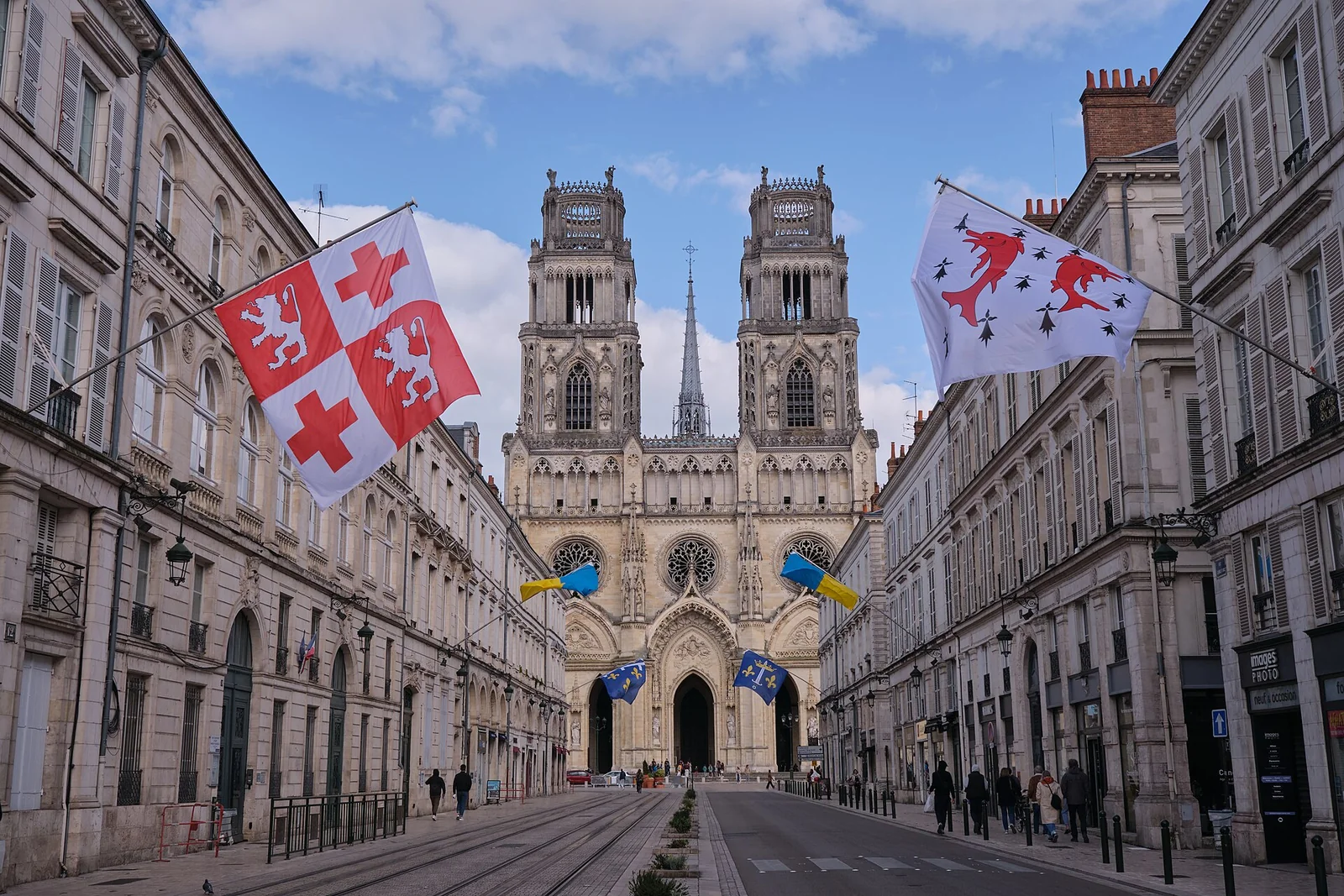
Sainte-Croix Cathedral is easy to recognise from its two towers and the long approach along Rue Jeanne-d’Arc. Visiting becomes much more rewarding, however, once you separate three experiences: ordinary entry to a working church, an accompanied visit, and a separately organised climb to the upper parts. Their opening arrangements, physical requirements and costs are not interchangeable.
This guide explains how to plan arrival, read the architecture, explore the Joan of Arc windows and make sense of the monument’s different periods. Suggested routes depend on your available time rather than promising access to every corner. Practical information was checked on 10 November 2026. Worship, conservation work or a safety decision can alter the visit even during the published general opening hours.
1. The essentials before you go
| Need | Published information | What it means |
|---|---|---|
| Location | Place Sainte-Croix, Orléans | Check the entrance in use that day |
| November–March | Daily,9 am–6 pm | Keep daylight for exterior views |
| April–October | Daily,9 am–7 pm | Avoid arriving at the final minute |
| Ordinary visit | Free | A contribution may be welcomed |
| Upper parts | Contact the tourist office | Separate reservation and conditions |
These details come from the official visiting page. For a quiet visit, look for a period away from worship and ask whether any area closes earlier than the building. Around an hour is a useful allowance for a first exploration. It is a planning suggestion, not a compulsory duration or a description of a ticketed product.
2. A short timeline that makes the building easier to read
Sainte-Croix looks remarkably coherent, but its history is a sequence of interruptions and renewed building. The Gothic project began in 1287. Destruction in 1568 during the Wars of Religion transformed the site. Royal reconstruction started in 1601, and the cathedral was inaugurated on 8 May 1829. The French Ministry of Culture places those stages in their political and architectural context.
This explains a common mistake: assuming that every Gothic-looking stone must be medieval. At Orléans, continuity of style was also part of a later rebuilding project and a statement about the monument. Successive rulers supported a cathedral associated with both the city and the monarchy. You can read it as a long conversation between an old design, destructive events and a desire for continuity.
Remember four dates rather than trying to carry an entire chronology around the church. They will help you ask useful questions: which parts relate to the older choir, how does a later campaign maintain the architectural rhythm, and what do the royal references mean? The purpose is not to date every block by eye. It is to understand why a building made over such a long period can still have a powerful overall unity.
3. Approach the façade through the city
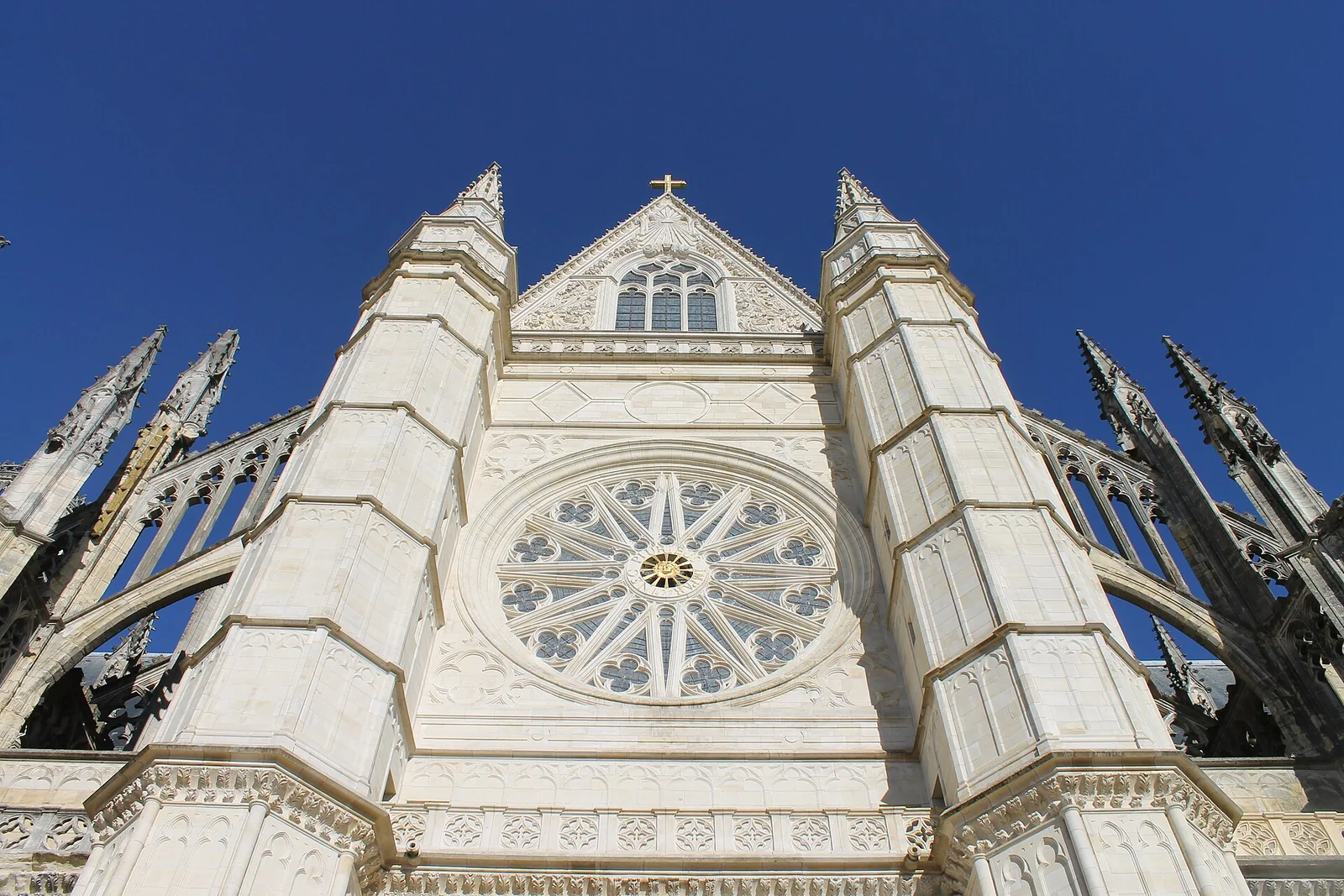
Start along Rue Jeanne-d’Arc. Notice how the street frames the towers, then move closer until the scale of the details changes. A distant photograph describes the cathedral’s place in Orléans; a closer one describes portals, decoration and shadows. Both are useful, and neither requires standing in the middle of a traffic route.
On the square, follow the façade gradually from bottom to top. Identify the main openings and the horizontal levels that organise its height. Looking in stages is often more effective than immediately hunting for a single small feature. If the light flattens the relief, visit inside first and return later. Exterior observation is flexible, so there is no need to obtain every photograph before entering.
If travelling with others, agree where to meet before splitting up for pictures. Events can change the layout of the approaches and pedestrian movement. Keep a simple mental map of entrance, exit, resting point and onward direction. Our Old Town walking circuit links Sainte-Croix with the surrounding quarter and helps you see that the approach is part of the experience rather than merely the route to a door.
4. The nave: look at the space before the individual details
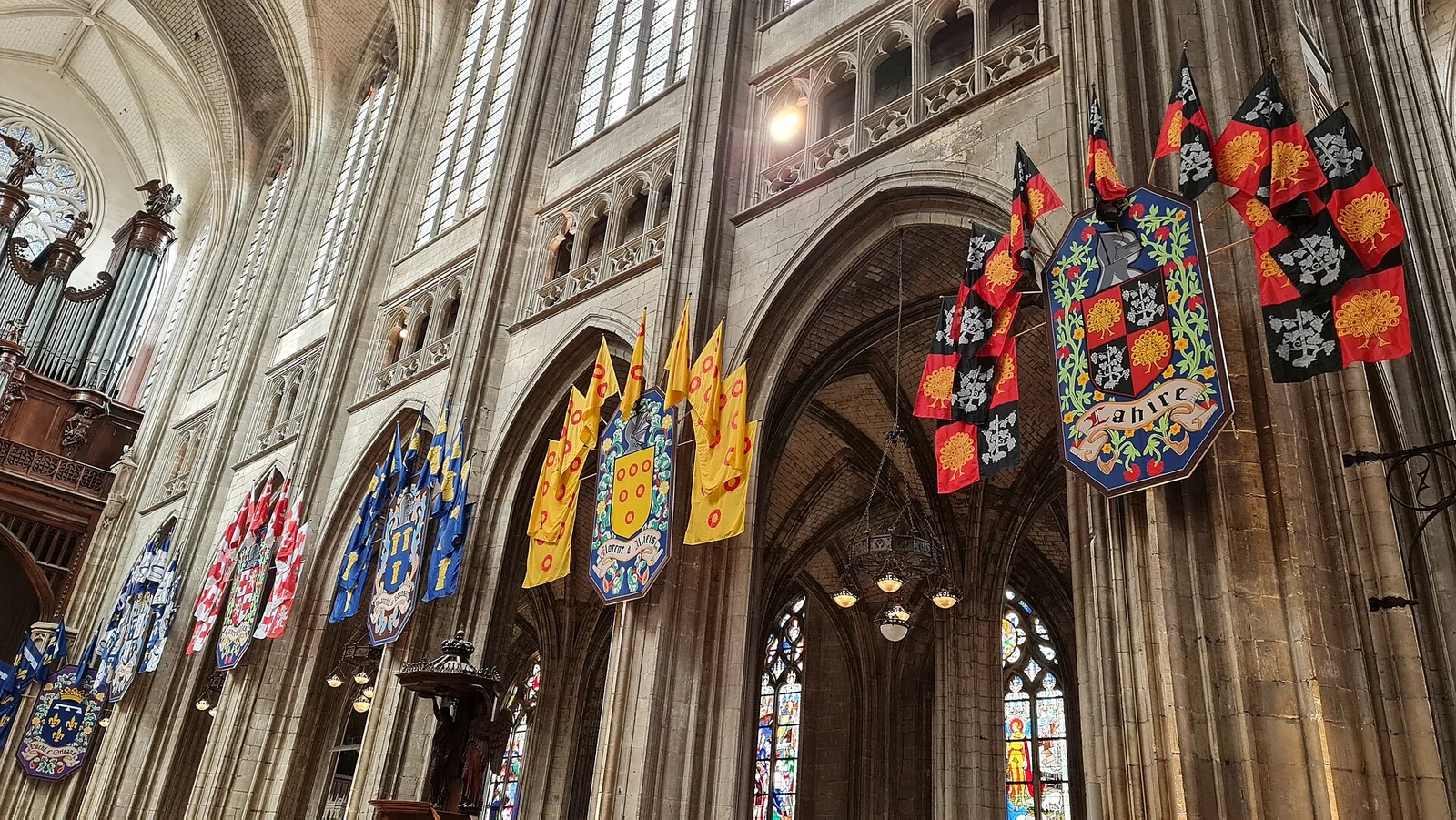
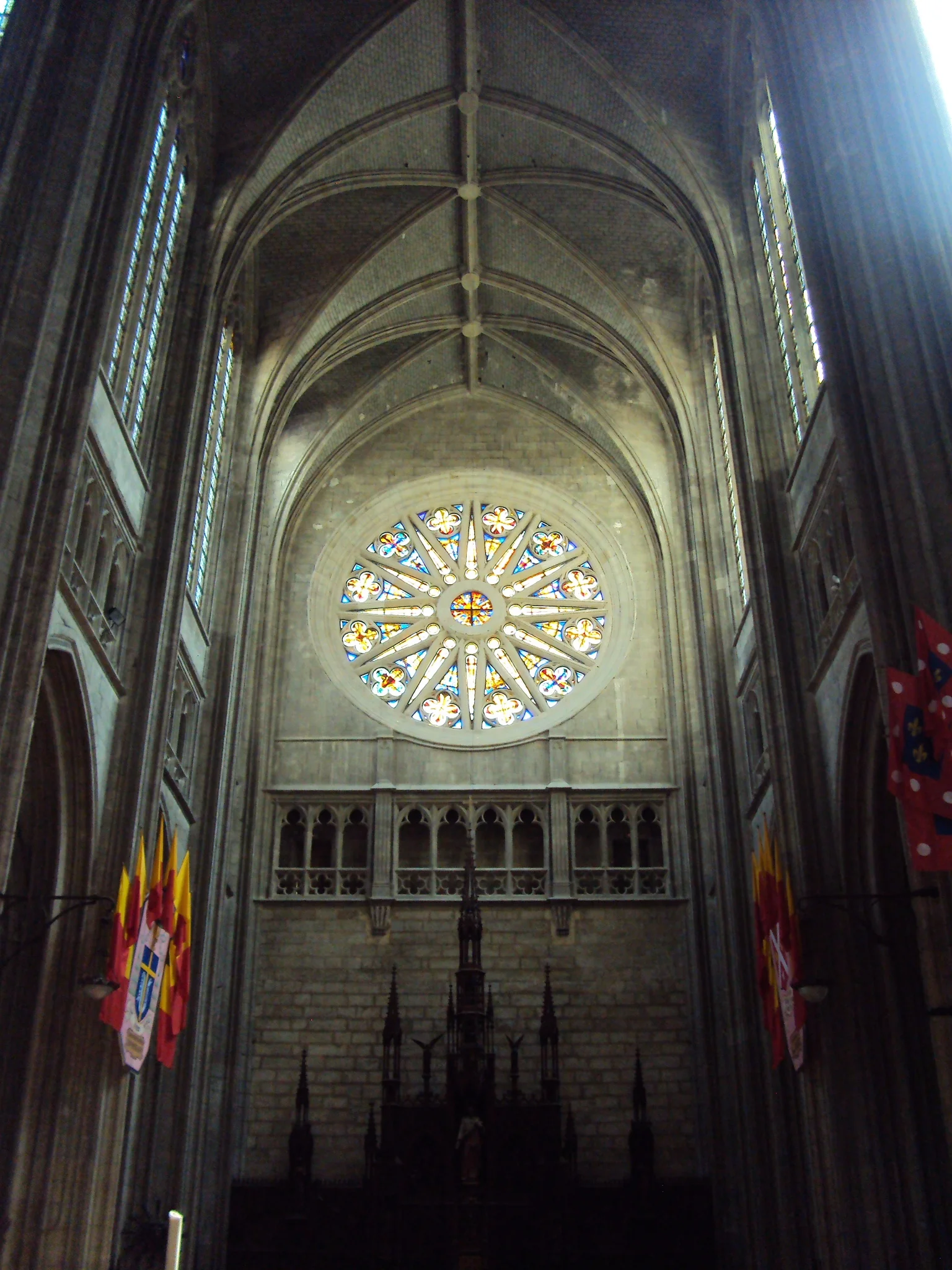
After entering, stop somewhere that leaves the passage clear. Give your eyes time to adjust and look down the nave. Pillars, repeated bays and openings establish the structure. That initial view makes the details easier to understand later: stained glass becomes part of an organised architectural setting rather than a collection of unrelated bright pictures.
Move slowly through a permitted part of the nave, then look back. The new viewpoint changes the sense of depth and the relationship between spaces. You do not need specialist vocabulary to notice repetition, a change in rhythm or a contrast between light and shade. Keep one question to ask a volunteer if someone is available, instead of guessing the purpose or age of every feature.
The seating is not simply visitor furniture. People may be praying or attending worship independently of the sightseeing route. Speak quietly, avoid cutting through a group and respect reserved areas. If part of the church is unavailable, adapt the route. A respectful visit can be rich and complete without reaching every camera angle imagined from a plan before departure.
5. Read the Joan of Arc windows as a sequence
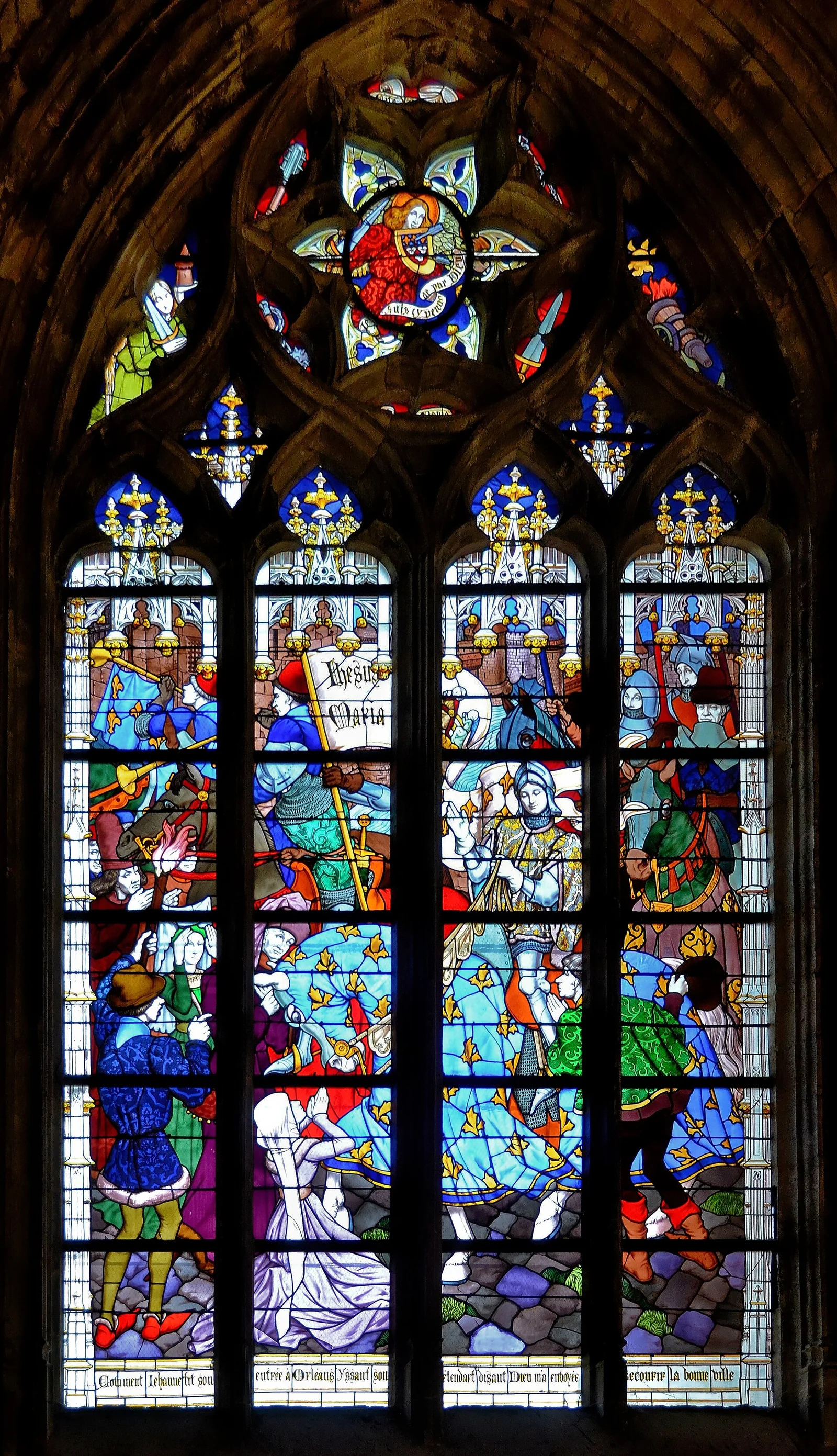
The Joan of Arc windows provide one of the most useful narrative threads inside the cathedral. The official leaflet page offers a dedicated guide to the ten windows in the lower aisles. Download it beforehand or ask about a paper copy. It prevents you from identifying an episode only by an armour detail, banner or crowned figure.
Choose one scene first. Where is the main character? How do gestures and lines direct the eye? What identifies an event or setting? Then compare the neighbouring scene and how the story continues. That approach is more effective than photographing all the windows quickly and hoping to reconstruct the narrative from small images after returning home.
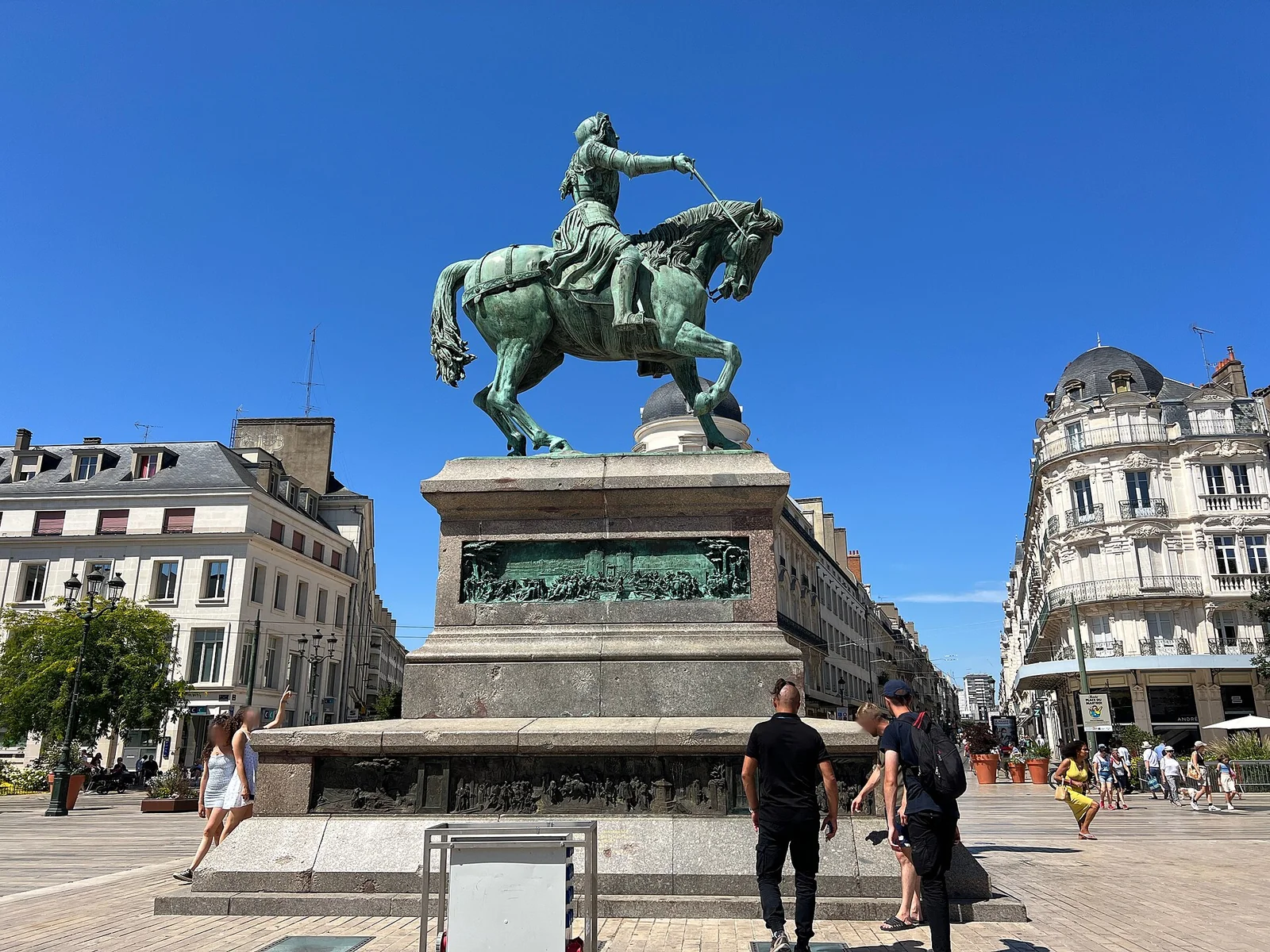
Also separate the historical subject from the date of its representation. An image of 1429 was not necessarily made in 1429. Costume, colour and arrangement also tell you how Joan was remembered later. Compare that treatment with the Martroi statue and the House. The Joan of Arc route develops this distinction between an event, an artwork and a commemorative tradition.
6. Choir and chapels: slow down for a more attentive visit
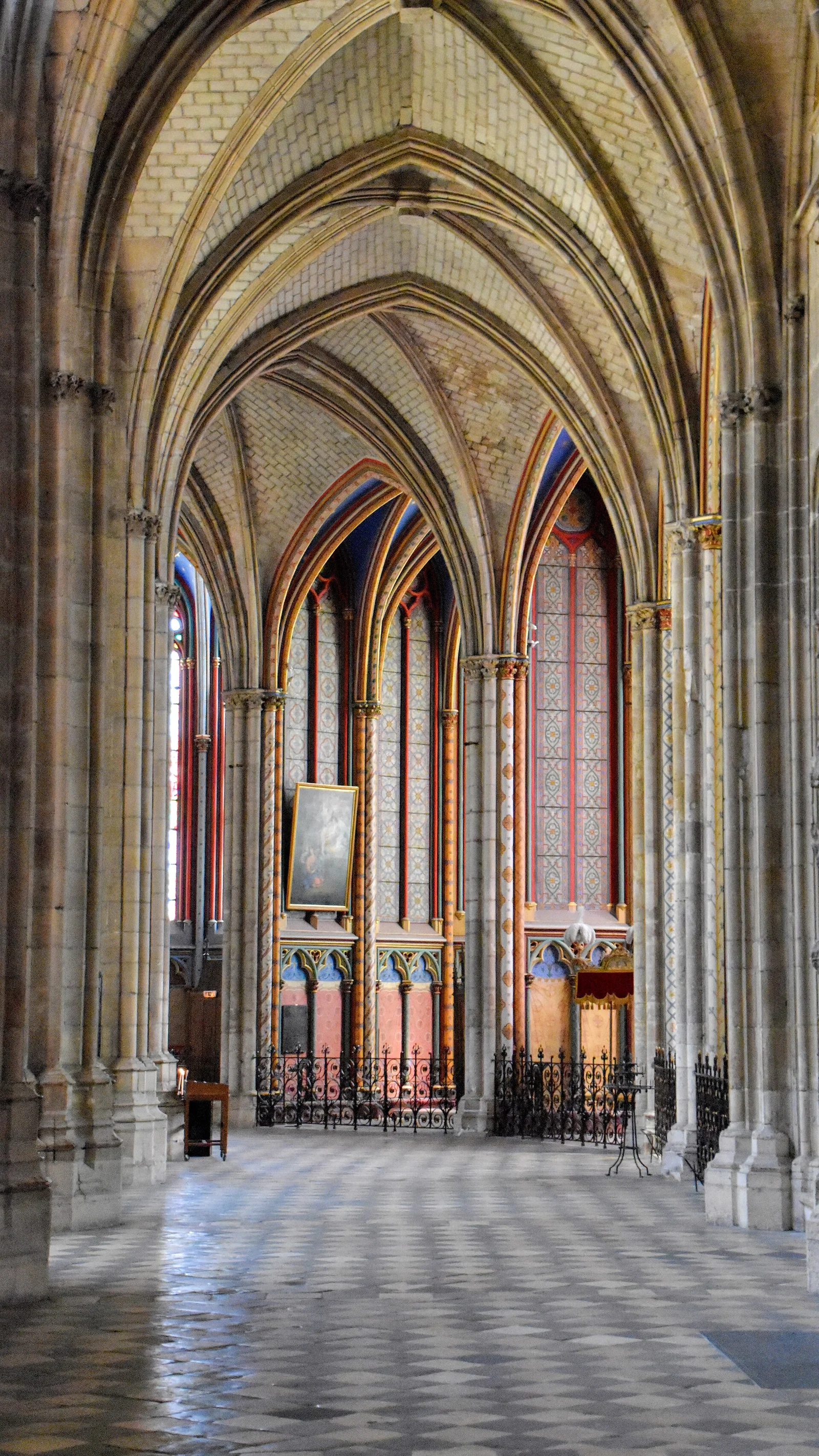
The official chapel leaflet describes fifteen chapels around the choir, dating from the thirteenth and fourteenth centuries. What you can see naturally depends on the areas open to the public. Do not walk around a barrier to check a detail. Use the plan or ask at the welcome point. Start with one accessible chapel and look at how painting, glass and furnishings work together.
The mixture of periods is especially interesting here. Restoration, nineteenth-century decoration and more recent work occupy an older architectural setting. The chapel document helps explain those layers. Conservation does not always return a building to one supposedly perfect date; it can make several states and later choices visible.
Where the visiting conditions allow it, leave time to observe the choir woodwork. Look at rhythm and its relationship with the architecture before trying to name every motif. The official website’s detailed images can help with an object that is distant or poorly lit during your visit. They extend curiosity without requiring flash photography or movement into a protected space.
7. Royal references, light and useful comparisons
Sainte-Croix’s royal connections are more than a decorative subtitle on a brochure. They help explain the rebuilding and some of the decoration. The Loiret tourism material draws attention to the transept rose windows and the memory of Louis XIV. Use documented explanations rather than attributing a royal meaning to every flower or carved face you happen to notice.
Make the visit active with three comparisons: stone against glass, the whole space against a small detail, and an old subject against a later representation. These are accessible to a non-specialist and give you a reason to slow down. A few lines in a notebook or a simple sketch can preserve more than a long sequence of very similar photographs.
Light changes perception. A brilliant window may make the neighbouring stone look dark, while your eyes and camera handle that contrast differently. Do not assume that a feature has disappeared simply because it is hard to see from one point. Move within permitted areas, wait briefly and accept that part of the discovery may come through the leaflet or a guide’s explanation.
8. Three routes according to your available time
| Time | Priorities | Leave for another occasion |
|---|---|---|
| 30 minutes | Façade, nave volume, one window | Detailed chapel reading |
| 60–75 minutes | Façade, nave, window sequence, accessible choir | Upper parts and specialist study |
| Two hours or more | Documents, comparisons and guidance if available | A second large museum without a break |
For a short visit, begin with what you can actually see instead of spending most of the time reading history outside. For an hour, alternate observation with small pauses. For a longer exploration, select a theme such as the building campaign, Joan of Arc or the chapels. Attention lasts better when the scale and type of looking change during the route.
These durations are not guaranteed by the cathedral. Worship may shorten the route, while a conversation with a volunteer may enrich it. If Sainte-Croix is the main reason for your trip, keep another possible slot rather than relying on the hour before your train. The three-day Orléans plan leaves room for that flexibility.
9. Volunteers, Petits Midis and digital resources
The cathedral distinguishes different kinds of guidance. Volunteers offer free visits, and the welcome team can help with enquiries. For a historical or cultural tourism-office visit and for the upper parts, follow the organiser identified on the official page. Two visits to the same building may have different aims, meeting points and conditions.
The Petits Midis are described as short, free visits on a particular topic, without registration, starting at 12.20 pm and lasting around twenty minutes. Check the linked programme to find the actual dates. It would be misleading to assume an automatic departure every day of the year. This format suits a focused curiosity rather than an exhaustive tour of the whole monument.
Leaflets and the BellesEglises digital resource also help you prepare or extend the visit. Download what interests you before entering rather than depending on mobile reception. Keep the phone silent and use an earphone for audio where appropriate. The screen should support the visit; spending the whole time scrolling can make you miss the scale and atmosphere of the place itself.
10. Climbing to the upper parts: questions before purchase
The climb is not an automatic extension of free entry. The rectorate directs upper-parts enquiries to the tourist office. One particular official product, Orléans de Haut en Bas, mentions 252 steps, a minimum age of twelve, April–October availability and a reservation to be made by the gift-voucher recipient. Those conditions belong to that offer; do not apply them without checking to every product using the word “cathedral”.
- Open the exact product and choose the intended date.
- Check meeting point, duration and guiding language.
- Read age guidance, staircase requirements and footwear instructions.
- Check weather conditions and cancellation or rescheduling rules.
- Confirm the final price and included areas before payment.
- Save the booking and allow time to arrive at the right place.
A gift voucher may not reserve a place on your preferred date. If the physical conditions do not suit someone in the group, choose a ground-level plan together. Façade, stained glass and city views already form a substantial experience. There is no reason to treat a visit without a climb as an unsuccessful or unfinished version of the cathedral.
11. Accessibility, tiredness and comfort
Ask precise questions according to your needs: approach from the square, thresholds, internal route, seating, passage width and any current work. A general statement that a place is accessible does not describe every route or activity. The nave and an upper-level staircase are very different situations. Prepare questions in advance if transfers or particular assistance are required.
A large church can feel cool even when the weather outside seems mild. An extra light layer can make a slow visit more comfortable. For visitors sensitive to sound, a service, rehearsal or group may change the atmosphere. Returning at a quieter time is a reasonable choice, not a failure to appreciate the building.
With limited walking capacity, reduce backtracking and choose a clear order for the features you want to see. Plan a nearby break afterwards instead of immediately starting a long descent to the river. Transport and pavement conditions deserve as much attention as the entrance itself. The TAO network provides current information for planning the journey from your actual starting point.
12. With children: make observation the activity
The official family page offers a leaflet, comic and treasure-hunt resources. The treasure hunt has a shorter version of roughly thirty to forty-five minutes and a longer version of around an hour to ninety minutes. Read the guidance attached to the chosen resource. A suitable tool is better than turning an adult explanation into a long speech that children must simply stand still and hear.
Before entering, give one small task: find a colour, identify a character or compare two sides of a space. Alternate looking with a question. Avoid games that encourage running, because the aim is to notice more rather than finish first. For a younger child, a short period of real engagement can be more rewarding than completing every point while becoming exhausted.
Ask where useful facilities are before beginning a longer activity. Keep snacks for outside and explain the rules of a working church calmly. After leaving, use a square or a short walk as the next stage. The Hôtel Groslot quarter offers a nearby change of scale; you do not always need a long journey to a distant attraction to balance the morning.
13. Photography and respect for the place
Read displayed instructions before photographing. Avoid aiming at worshippers, blocking a passage or setting up bulky equipment without permission. A handheld camera and a discreet manner usually fit the place better than a prolonged arrangement of lights or stands. For professional or commercial use, ask the competent organiser about the conditions rather than assuming that permission to enter covers every kind of production.
For a useful set of images, begin with the whole space, then a window detail and a relationship between stone and light. Excessively increasing screen brightness can distort your perception of colour. For a very bright window, accept that neighbouring areas may be darker. A clear subject often works better than trying to make every part of the scene equally bright.
Outside, the street and square offer several viewpoints. Respect rails, crossings and temporary signs. No architectural detail justifies a dangerous position. If a ceremony or building work hides part of the façade, try another angle or return later. The city does not need to stop functioning so that a photograph matches an image found online.
14. Budget, breaks and nearby places to combine
The basic ordinary visit can cost nothing: enter freely, use available resources and observe the exterior. Keep any voluntary contribution, booked experience, purchased publication and refreshments separate in your budget. A price shown by a third-party tour provider is not the universal admission charge for Sainte-Croix. Establish whether the product is a tour, transport package, gift voucher or several activities combined.
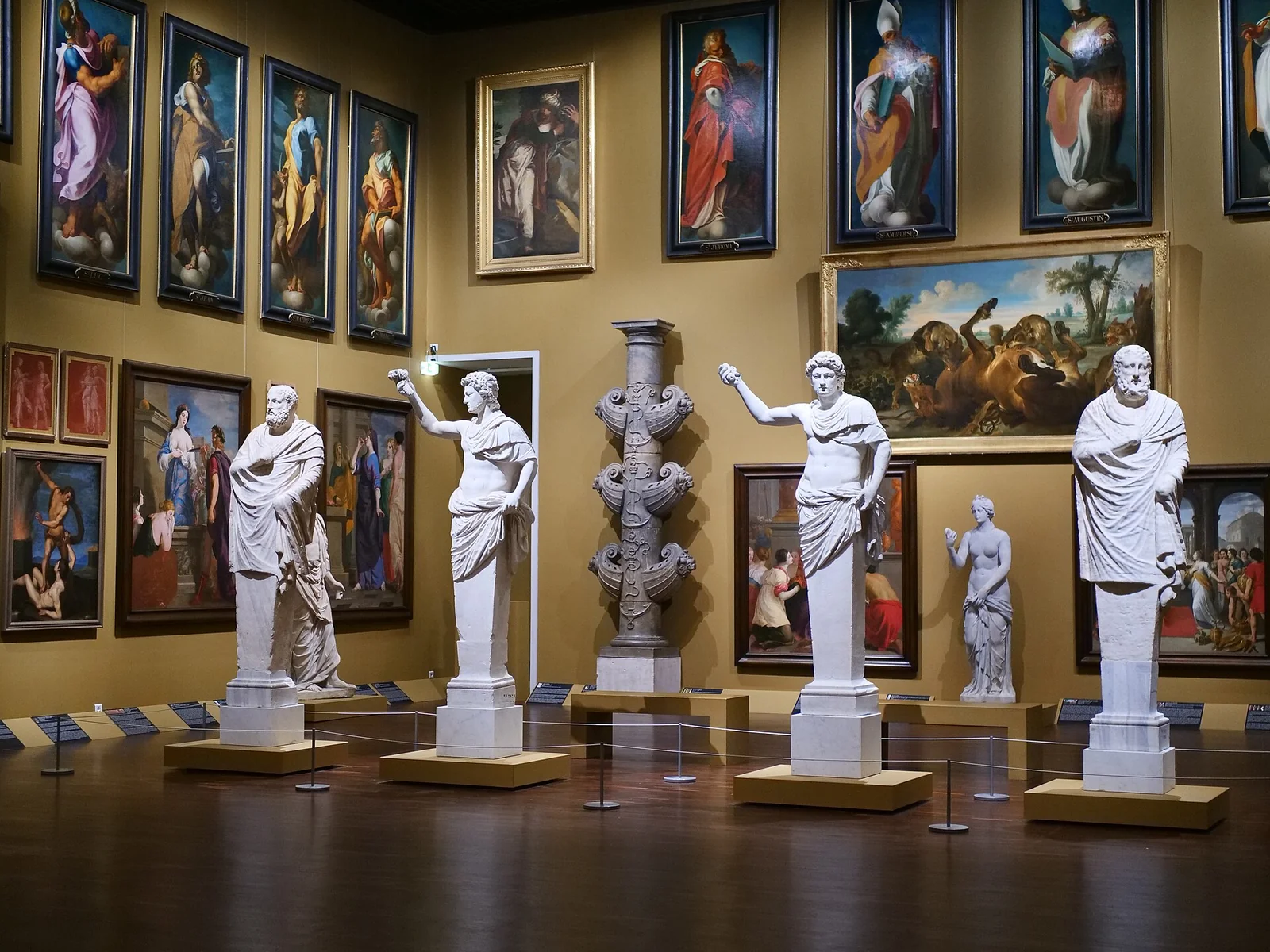
Groslot pairs naturally with the cathedral for a comparison between religious monument and Renaissance mansion. The Museum of Fine Arts deserves longer and a different level of attention. Joan of Arc’s House contributes another perspective on local memory, but its low-season afternoon opening affects the sequence. Being close together on the map does not mean that every attraction should be fitted into the same morning.
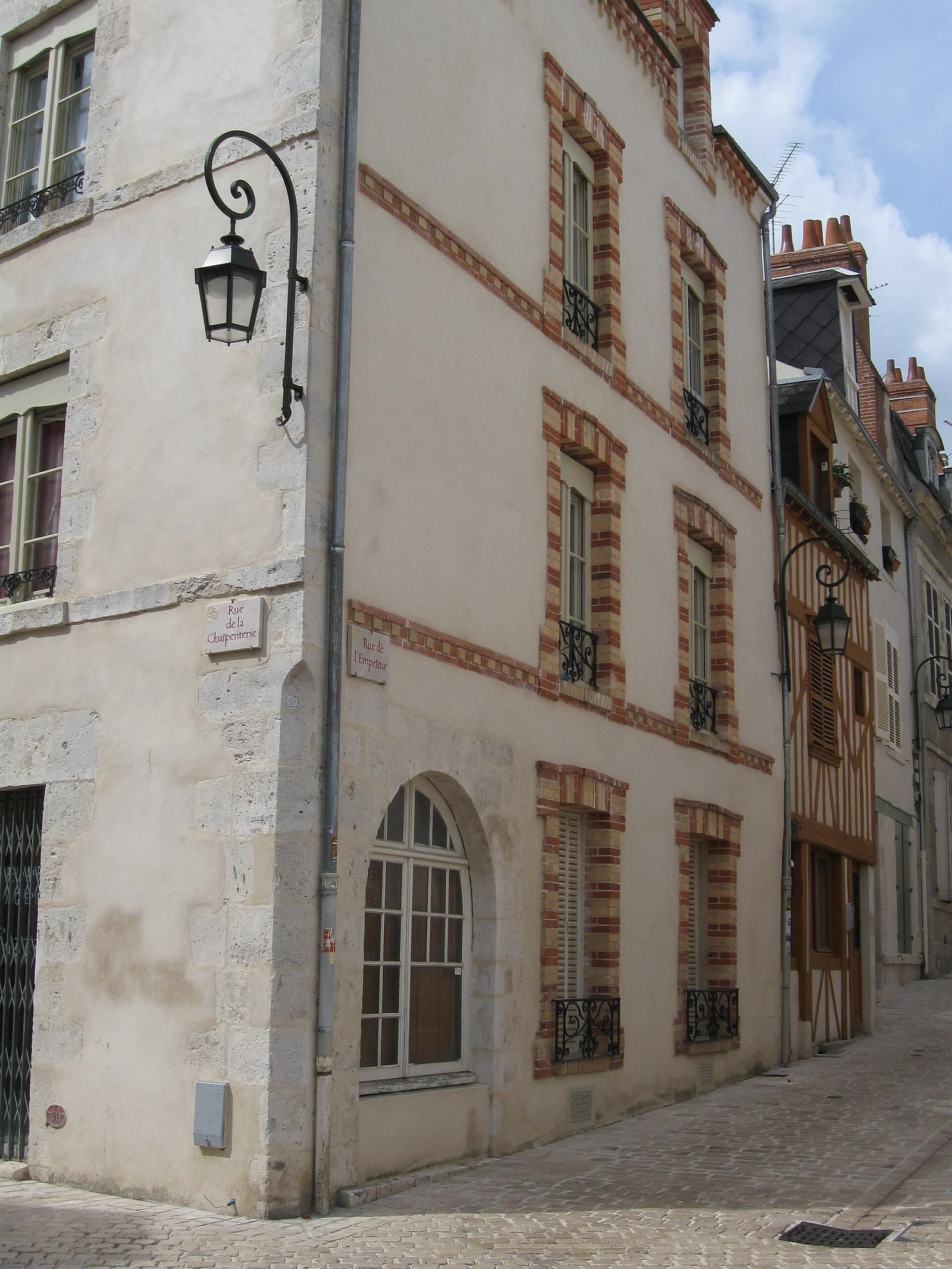
After looking carefully inside, continue into the old streets or towards the Loire. The riverside route changes the experience from a monumental interior to an open landscape. For food, choose by actual menu and kitchen hours using the Orléans food guide. A well-placed break protects your attention for the rest of the trip.
15. Continue the discovery after leaving
A good cathedral visit does not end when you cross the doorway. Keep one or two questions that arose while looking: why a style was maintained, how a window tells its story, or what a restoration has revealed. The official leaflets and heritage publications can answer those questions more effectively after you have seen the spaces they describe.
If you made photographs, organise them by viewpoint or theme rather than collecting every file without context. Note which detail actually interested you. This helps distinguish an object’s subject from its date and avoids repeating a mistaken caption later. A photograph of Joan of Arc, for example, needs to identify the window or monument rather than implying that it is an image made during her lifetime.
For another visit, choose a focused theme instead of attempting exactly the same circuit more quickly. The nave windows, chapel decoration and relationship with the city each support a different route. Repetition becomes worthwhile when the question changes; it is less useful if the only aim is to reproduce the same set of photographs in slightly different weather.
16. Services, closures and your backup plan
A cathedral does not operate like a museum offering an identical route with every admission. Worship may limit movement, conservation may cover a feature, and an event may change the approaches. Ask what remains possible and choose a nearby alternative rather than declaring the whole day lost. A planned route is a useful guide, not an entitlement to every space.
Rain may make the main interior appealing, but it does not guarantee that every planned activity can operate. A climb has its own conditions. If the cathedral is temporarily unavailable, a nearby museum or another covered visit may work according to its hours. Keep the theme of the day while changing the order, rather than repeatedly travelling across the city to rescue a rigid schedule.
For a gift purchase, read the voucher conditions separately from the tour description. The consulted Haut en Bas gift page describes a one-year validity and a non-refundable, non-exchangeable voucher, with a later reservation still required. A present bought for someone who cannot manage the staircase may therefore be difficult to adapt. Check suitability with the recipient before treating it as a flexible alternative to an ordinary admission ticket.
17. Map and official sources
Open Sainte-Croix in Google Maps to locate the square and surrounding quarter. Adapt the final approach to works and mobility needs instead of following a vehicle arrival point blindly.
🗺️ Your planning map
Load the map when you need it, or open directions directly. Loading the map connects to Google Maps.
Open in Google Maps ↗- Cathedral: hours, free visiting and guidance.
- Cathedral: windows and chapel leaflets.
- Cathedral: family resources.
- Ministry of Culture: historical context.
- Tourist office: the specific Haut en Bas offer.
Last practical check:10 November 2026. Read the exact conditions of the special visit or gift product you are actually reserving.
Frequently asked questions
Is cathedral entry free?
Ordinary visiting is free. Volunteer tours advertised by the rectorate are also free, with a contribution welcomed. Special tourism-office products are separate.
What are the winter hours?
The official page gives daily 9 am–6 pm opening between November and March, subject to worship and local visiting arrangements.
Can I climb the towers independently?
No. The official page directs upper-parts enquiries to the tourist office. Choose an offer and date and read its conditions.
Is a climb suitable for every child?
Each product has its own rules. The consulted Haut en Bas offer lists a minimum age of twelve and 252 steps; always check your actual product.
How long should I allow?
About an hour is a useful suggestion for a first ground-level visit. A guided product has its own published duration.
Are the Joan of Arc windows explained?
Yes. The cathedral offers a leaflet covering the ten lower-aisle windows and a dedicated spiritual route.
Can I sightsee during worship?
Movement should be limited and worship respected. Ask the welcome team what is possible and return later where necessary.
What if the upper parts are unavailable?
Explore the nave, windows, accessible chapels and city views. The ground-level visit is a substantial experience in its own right.